



Defiance-IX, 2.5 million light-years from Earth
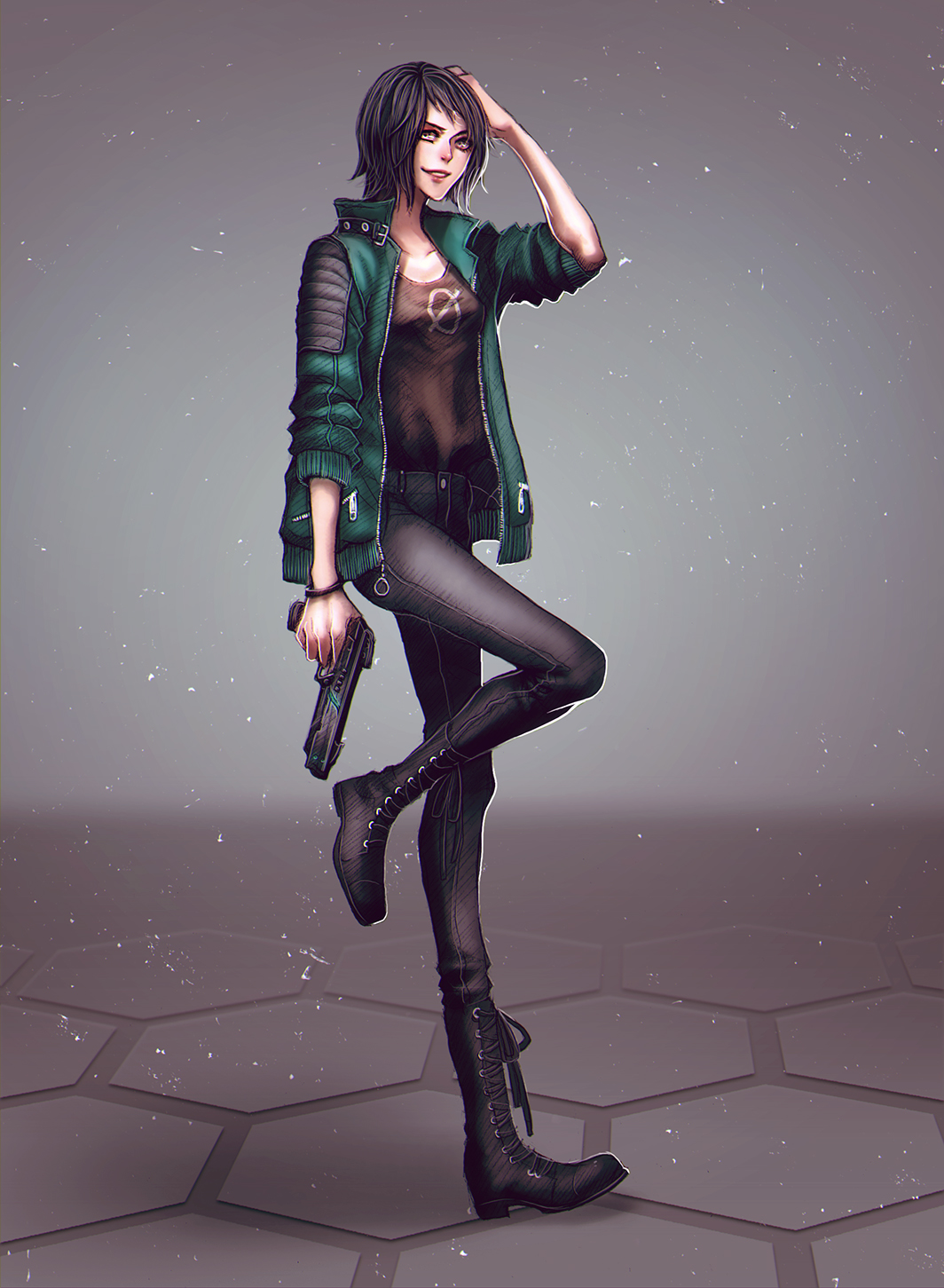
Vesta is holding the decapitated body of Medusa, floating over the floor to avoid stepping on the pool of green blood.
While she doesn’t rejoice for her death, she’s relieved by the ending of her killing spree and for what this means for the victims of her petrification power.
She almost drops the body when she’s surprised by the sudden flash of light that precedes the reformation of Quantum’s body. And suddenly she’s surrounded not just by her teammate, but by the crew of the Defiance-IX which is no longer composed of statues.
<What did just… whoa.> Quantum says, staring at his teammate holding the corpse.
<I didn’t kill her.> she immediately justifies herself.
<What happened here?> the first officer asks, quite confused.
<Medusa transmuted you all into stone. Upon her death, the spell was broken and everyone returned to normal.> Vesta explains while looking at Quantum.
<Makes sense, I was locked into stone last time. So why aren’t you back to normal?> he asks.
The situation is too strange for any of the crew to have commented on it, but while she’s still able to move Vesta’s body is still visibly made of stone.
<I have no idea. Hopefully Noriko will be able to…> Vesta responds, when Medusa’s body vanishes from her arms.
Quantum recognizes the energies created by space itself warping around the goddess… the unmistakable signature of Skorpios.
<I don’t think Noriko was the one to kill her.> he says.
A pocket dimension tangential to the universe
As holder of the Manifold device, Skorpios has access to any place in conventional space.
But she’s made too many enemies to consider any point of the universe a safe environment; an old ship parked in this small extradimensional realm, barely larger than the ship itself, serves as her most secure hideout.
The body of Medusa is unceremoniously dropped on the floor. Skorpios doesn’t pay much attention to it, busy sitting on a bed medicating herself: Torn’s Aether blade lacerated both one of her cybernetic implants and one of her synthetic kidneys.
<Cozy place you have here.>
As far as Skorpios knows, she is the first sentient being to ever discover this dimension. So when she hears another voice, she reaches for her gun.
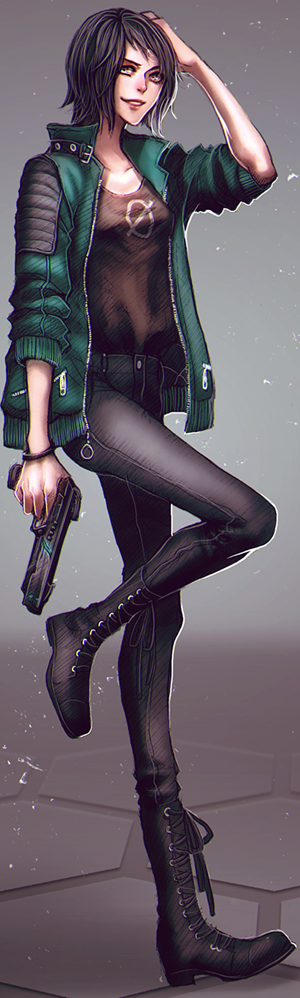
For a moment, she believes she’s facing Noriko Null. She has her voice, her face, her silver eyes… but this one has longer hair, and Skorpios can sense her soul is completely different.
<You’re not her. How many clones does that woman have!?>
<My name is Rei. You can put down that weapon unless you intend to use it. Which is not something I would recommend.>
<Why shouldn’t I shoot you? Medusa told me about you. You just tried to use her.>
<Says the woman who decapitated her own ally and used her as a weapon.> Rei points out.
<She’s not permanently dead. She’ll resurrect herself, that’s what she does. How did you find this place? How did you follow me?>
<I am Rei Null. That’s what I do.>
<That’s not an answer.>
<Your use of the Manifold leaves an easily traceable warp signature. Well, easily for me. And adjusting my own portal technology to the transdimensional shift was…>
<What do you want?> Skorpios asks.
Rei gets closer, sitting next to her. Something about her presence makes her nervous.
<Stop trying to poke my soul. You won’t learn anything about me. And quite frankly, my mind is not a nice place to be.> Rei tells her.
<No tricks. Whatever measures you have to prevent me from teleporting you into a star, I assure you they won’t work.>
<Skorpios, if I wanted you dead, we wouldn’t be having this conversation. I’m here to ask you two questions, then to make an observation… and a proposal.>
<No tricks. I studied under Ulysses, I can smell a con job a light-year away.>
<First question. You just liberated the Aegian Galaxy from its ruling gods: what are you going to do once Medusa resurrects herself?> Rei asks.
<We kill other gods. We won’t rest until they are all dead.>
<Just as I thought. Second question: do you know how to find them?>
<Most gods aren’t shy about making themselves known. We’ll find them. Are these seriously the only questions you wanted to ask me!?>
<I needed them for my observation. The only reason you reached the Aegian Galaxy is that Ulysses took you there. The Manifold gives you access to the entire universe, but that’s a big place. You can’t even find on your own all the galaxies ruled by gods, can’t you? The Manifold gives you the range, Medusa gives you the power, but you lack one thing to reach your goals: information.>
<And I assume this is what your proposal is about.>
Rei pulls something out of her pocket: a tiny metallic disk, the size of a coin. Skorpios recognizes is as the kind of data storage Ulysses used for sensitive information.
<I thought this format was appropriate for nostalgic reasons. This disk contains the coordinates of five galaxies currently under divine rule: Abydos, Karnak, Irkalla, Uruk and Babylon. Including those of the capital worlds of all of its gods.> Rei explains.
<You’re leaving out two. Olympus and Naqada… the galaxy that you currently rule.>
<Here is my proposal, Skorpios. I will give you this disk: it will grant you everything you need to liberate all these galaxies from divine rule. But I want something in return.>
<I could take that disk from you.>
<I am the smartest being in the universe. How confident are you of breaking my encryption algorithms?>
Skorpios considers it. She’s reminded of something Ulysses told her about facing Null: “don’t engage her on technological grounds. You can’t beat a grandmaster at her own game”.
<What’s the price?> Skorpios asks.
<You will attack those galaxies first, I don’t care in which order. Only after you are done, I will personally deliver to you all the gods currently residing in my galaxy.>
<And what about the Olympian galaxy?>
<I have vested interests there. By the time you are done, its gods will be long gone. But in the unlikely case any of them survived after I have killed Noriko, they will be yours.>
<Tempting. But your generosity is suspicious, Rei. Why do you want to kill all gods?>
<The same reason you want to.>
<You don’t strike me as the type who would care for the well-being of her fellow mortals.>
<You and I are quite different, Skorpios, but we have one thing in common: the existence of gods is a roadblock to achieve our destiny.>
<And what would be my destiny?>
<To finish what Noriko has started. To be the Second Slayer of Gods.>
<I had not… considered myself as her successor.> Skorpios realizes.
<What else would you be? You accomplished in days what she took years to achieve, and unlike her you are not wasting time negotiating for peace while the war is still going.>
<I still don’t think you are trustworthy, but… this is too big of an opportunity to waste. I accept your proposal.> Skorpios says, taking the disk from Rei’s hand.
<An excellent choice. If I were you, I wouldn’t disclose this deal with Medusa… as a goddess, she’s unreliable. She’s not like us.>
<Right. I do have one last question though… what destiny are the gods preventing you from achieving?>
Rei snickers as she stands up, activating her dimensional transporter.
<What else? To succeed Kronos on the Throne Of The Universe and be the supreme ruler of all known space and beyond.>
Null Tower, Midgard City, Earth
Getting out of the Empyrean dimension took a lot out of Torn’s use of Aether; the job of carrying the petrified form of Roxiana to Noriko’s laboratory has been taken by Gilgamesh.
He doesn’t mind the physical part of this… the demigod has strength to spare to move a simple statue… but he can see the botched mission has taken a toll on Noriko.
<Where should I put her?> he asks, looking around. They couldn’t go back to the Null Tower of New York City, after its destruction at the hands of Medusa; its counterpart in the Antarctic city isn’t as well-furbished, and Noriko hasn’t used the lab for so long that it’s full of half-finished projects and miscellaneous equipment.
<Wherever you find space. Didn’t I use to have a mass spectrometer around here somewhere?>
After placing the statue, Gilgamesh touches the Absolute Defense bracelet on her wrist: it’s still intact, the only part of Roxiana that wasn’t turned into stone.
<Shouldn’t this have protected her from the transmutation?>
<I don’t know. Dammit, I’ll have to build a new one from scratch.>
<And shouldn’t she have turned back after Medusa’s death?> Gilgamesh wonders.
<I don’t know, okay!? I don’t need any more reminders of how much I suck at this!> Noriko shouts, her silver eyes shining in anger as she throws a randomly picked wrench across the room.
The object bounces off Gilgamesh’s bronze skin like it was nothing.
<Don’t be upset at yourself. You’ll figure this out.> he reassures her.
<I shouldn’t even be in this situation! Medusa is a bit player out of her depth and Skorpios is just a henchman with a stupidly powerful weapon. I’ve taken down multiple Primordial Gods, I should be able to handle crap like this in my sleep!> she rants.
<Perhaps you are tired. How long have you been using the Nexus without pause? You told me it’s bad for you to never take breaks.>
<Sure, taking a nap sounds like a wonderful idea. I will feel well-rested after I wake up and find Medusa has turned an entire galaxy into stone! Don’t you have anything useful to…> she yells, only to pause when she realizes she’s being unreasonably harsh.
<Sorry. I know you’re just trying to help, but… I’m not at the top of my game, and I don’t know why.> Noriko admits.
<Could it be that you share Medusa’s goals and feel tempted to join her cause?>
The voice came from behind Noriko. Once she turns, there’s a large bird perched on a pile of discarded computer parts.
<Because if it is so, this could turn into a problem and I might as well destroy this world.>
<Did that bird just talk?> Gilgamesh asks.
<Not just any bird, that’s a peregrine falcon. And considering who I’ve dealt with lately… is it a common Egyptian thing to show up unannounced, Horus?> she asks the bird.
<I considered bringing Ra here, but his presence alone would have melted this world. But you know Ra, he wouldn’t have said a single word anyway. And it is appropriate for me to meet the last mortal to fight alongside my mother.>
<Right. Sorry about Isis, Horus.>
<Don’t be. My pantheon accepts and understands death. And her unfortunate demise means that I am now the supreme ruler of the Abydos Galaxy. That helps deal with the loss.>
<I can imagine. Listen, I’m honored about the visit, but you can imagine I’m quite busy so…>
<Do you know why I never bothered to deal with your little crusade, Slayer? It’s because you have never been a threat to me.>
<I’ve heard that before. Mostly from gods I later killed.>
<None of which had the protection of the Eye of Horus: I can negate the powers of most gods.> the bird reveals, and as a demonstration his eyes suddenly shine red… and Roxiana moves.
<What… what just happened!?> Roxiana wonders, looking around in sheer confusion.
<We just made a new ally.> Noriko answers.